
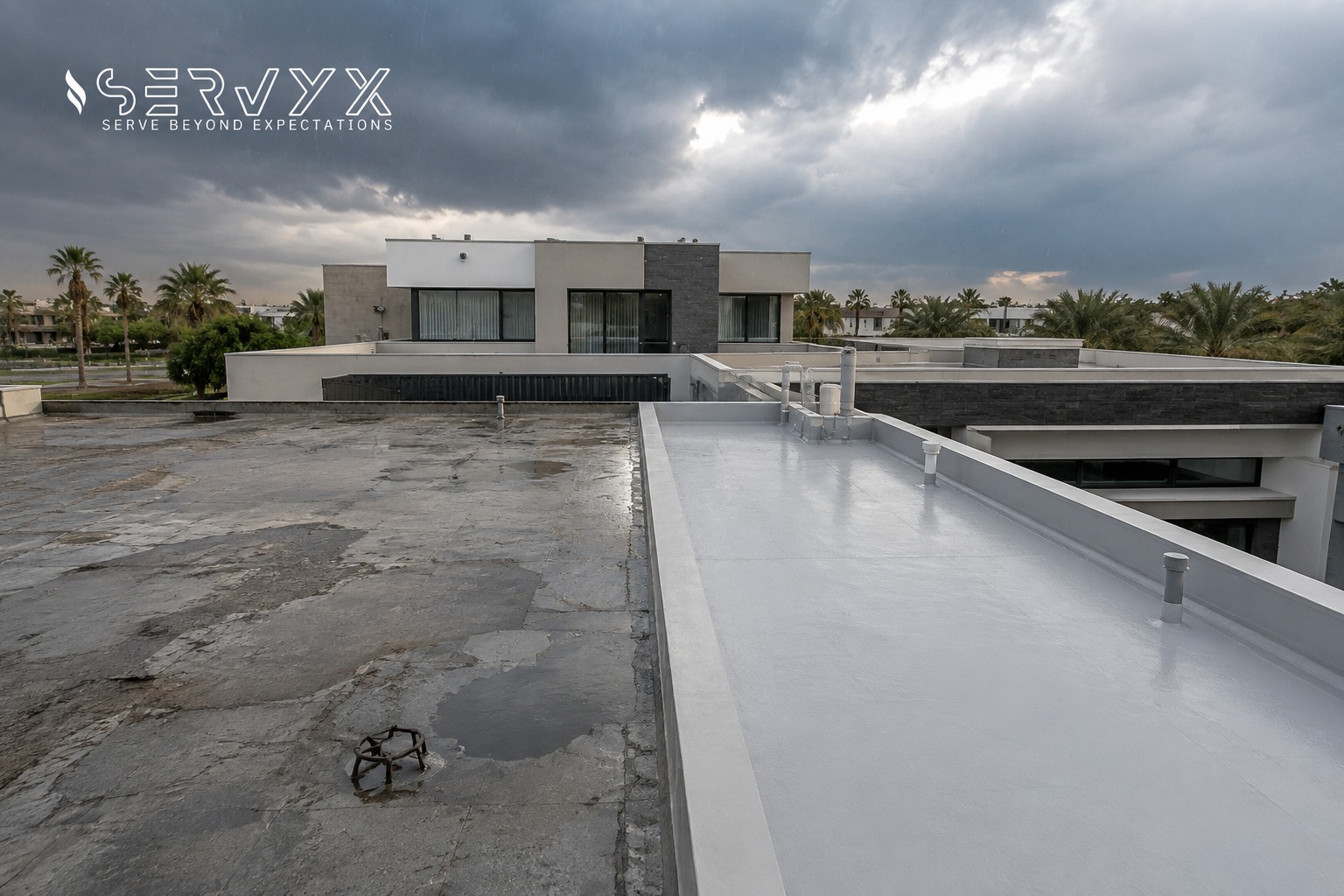
It happens every September in Dubai without fail.
Families come back from their summer in Lebanon, India, or Europe. They open the villa door, walk upstairs, and find a water stain spreading across a ceiling that was perfectly dry when they left in June.
The first question is always the same.
“But it barely even rained.”
That confusion is completely understandable. In most countries, a roof leak means heavy rain found a gap. In the UAE, that logic does not apply. By the time the first September shower arrives, the damage was already done during summer. The rain does not cause the UAE villa roof leak. It simply finds the gap that three months of extreme heat quietly created.
This article explains exactly why that happens, what the five specific causes are, and what you can do before the next rain season turns a manageable issue into a repair bill that nobody budgeted for.
Most villa owners in Dubai think about their roof twice a year.
Once when they see a stain on the ceiling. And once when they pay to fix it.
Everything that happens in between is invisible.
That is the core problem with roof waterproofing maintenance in the UAE. The failure process is completely hidden. A membrane can be actively degrading for two or three years before any visible sign appears inside the property. And by the time water staining shows on a ceiling, moisture has already been moving through the concrete structure for months, sometimes longer.
Understanding why this happens means understanding what UAE summers actually do to a roof surface that most people never see.
UAE rooftop surface temperatures in summer regularly exceed 80 degrees Celsius.
At night during winter months, the same surface can drop to 15 degrees or below. That is a swing of 65 degrees or more between the hottest and coldest point of the year. Every material on your roof expands and contracts with that temperature change. The concrete substrate moves. The screed moves. The waterproofing membrane moves.
The problem is that they do not all move at the same rate.
When materials with different expansion rates are bonded together and subjected to years of thermal cycling, stress concentrates at the bond points. Over time, that stress creates microcracks in the membrane. These cracks are not visible from the ground. They are not visible from walking across the roof. But they are there, and they grow a little more with every cycle of heating and cooling.
By year four or five of a UAE villa roof’s life, even a well-applied membrane can have dozens of microcracks across the surface. When light rain arrives in September, it finds every single one of them.
Water stains appear on the ceiling after even minor rainfall. The stains often seem random, appearing in spots that have no obvious connection to a visible roof problem. Different stains appear in different rooms in different years as new microcracks open.
The UAE sits at a latitude where UV radiation levels are significantly higher than in Europe, the UK, or North America.
A UV protection coating on a waterproofing membrane that carries a ten-year performance rating in a German climate will begin showing meaningful degradation on a Dubai villa roof within five to seven years. In some cases, with lower-specification products, sooner than that.
UV degradation does not look dramatic from outside. The surface does not collapse or crack visibly. It chalks. It dulls. The protective compounds in the coating break down and the membrane beneath loses the UV barrier that was stabilising it.
Once that barrier is compromised, the primary membrane is exposed directly to UAE solar radiation. The accelerated degradation that follows creates brittleness and surface cracking. A membrane that was once flexible enough to accommodate thermal movement without splitting can no longer do so.
This is why the question of material specification matters so much for roof waterproofing in Dubai. A product not tested for UAE UV levels will fail significantly earlier than its rated service life suggests.
Often nothing visible, until the first significant rainfall. Then multiple small damp patches appearing simultaneously across different areas of the top floor ceiling. Because the UV degradation has been happening evenly across the whole surface, the first rain finds failures in multiple locations at once.
If there is one fact every Dubai villa owner should know about roof leaks, it is this.
Nine out of ten villa roof leaks do not start in the middle of the roof surface. They start at the edges.
Specifically, at the junction between the flat horizontal roof and the vertical parapet wall that runs around the roof perimeter. This is the most vulnerable point on any flat UAE villa roof, for a precise structural reason.
The horizontal roof surface and the vertical parapet wall are two separate structural elements. They are built connected but they move independently under thermal stress. Every time the temperature changes, they expand and contract at different rates and in different directions. The waterproofing membrane that bridges the junction between them is subjected to constant movement stress that no other part of the roof experiences to the same degree.
Even a membrane applied perfectly at installation will experience this stress. Over years of UAE thermal cycling, the junction seal deteriorates. Small separations develop. Water running toward the parapet finds these separations and travels behind the membrane, down through the wall structure, and eventually appears as a stain on the ceiling of the room below.
The same failure pattern occurs around drainage outlet collars, pipe penetrations, and anywhere the membrane changes direction or wraps around a penetrating element.
Professional waterproofing contractors in Dubai treat junction areas differently from field areas of the roof. Additional membrane layers, reinforcing fabric, and specific junction detailing techniques are required. When this detailing is skipped or abbreviated, junction failure is not a possibility. It is a timeline.
A water stain that appears specifically at a wall junction, near a corner of the ceiling, or directly below a drainage pipe position. The stain often tracks diagonally down a wall from the ceiling junction, following the path the water took through the structure.
Flat villa roofs in the UAE are designed to drain quickly after rainfall. The drainage system consists of outlets, channels, and deliberate falls in the roof screed that direct water toward the drainage points.
When these outlets become blocked with dust accumulation, windblown debris, or bird nesting material, water that would normally drain in minutes sits on the roof surface instead. In the UAE, where dust storms can deposit significant material on a roof surface between rain events, drainage blockage is more common than most villa owners realise.
Ponding water on a UAE villa roof is a significantly more aggressive threat than rainfall that runs off quickly. Standing water has time to find every imperfection in the membrane surface, every microcrack from thermal cycling, and every loose edge at a junction. It penetrates rather than runs off.
Beyond the immediate leak risk, persistent ponding adds weight load to the roof structure. This accelerates structural movement, which in turn accelerates membrane stress and junction failure.
The drainage outlet collars themselves are a separate concern. These were installed with the original waterproofing system and are typically the oldest and most degraded elements of the roof assembly by the time a villa reaches five to eight years old. The sealant between the membrane and the outlet collar is a common failure point that a professional roof waterproofing inspection in Dubai will always check.
Water stains appearing in the centre of ceiling areas rather than at perimeter walls or corners. Staining that appears after the first rain following a long dry period, when accumulated debris has been sitting on a blocked outlet through the summer.
This is the root cause that nobody in the UAE property market discusses openly, but which Servyx encounters regularly on inspection visits.
A substantial proportion of waterproofing applied to Dubai villas, particularly properties completed between 2010 and 2022, was specified using products developed and tested for European or South Asian climates. These products were not re-specified for the combination of conditions that a UAE villa roof actually experiences.
Two millimetre membranes where four millimetre was the correct specification.
Standard bitumen products where torch-applied polymer-modified systems were required.
UV protection coatings with stabiliser loading appropriate for moderate sun exposure, applied to roofs that face some of the highest UV radiation levels in the world.
These materials do not fail immediately. Waterproofing failure is cumulative, not instant. The membrane performs adequately for the first two or three years. Then the combination of UAE thermal cycling, UV exposure, and junction movement begins to take effect. By year five, what was an adequate-seeming installation becomes an active roof waterproofing problem in Dubai.
This explains why so many UAE villa owners are dealing with roof leaks on properties that received professional waterproofing at construction and are still within what they understood to be the warranty period.
A roof that was professionally waterproofed failing significantly earlier than expected. Widespread staining across multiple areas rather than isolated single points. The pattern of a systemic specification failure rather than a localised application problem.
You do not need to wait for rain to assess whether your roof has an active waterproofing issue. There are visible signs that indicate a problem is developing, and identifying them before the September rain season is always significantly cheaper than discovering them after.
Go through every room on the top floor of your villa and look carefully at the ceilings and walls near the perimeter.
Any discolouration on a ceiling, even very slight yellowing or a barely visible ring stain, indicates that water movement has already occurred through the structure above. This is not a cosmetic issue. It is evidence of an active waterproofing failure somewhere above that point.
Check the paint on interior walls near the roofline, particularly in corners and at wall-to-ceiling junctions. Bubbling, blistering, or soft patches in paint indicate moisture in the wall from a parapet junction failure above.
Look at plaster cornices at ceiling-to-wall junctions on the top floor. Hairline cracks at these specific points can indicate movement in the structure caused by waterproofing that is no longer containing moisture above.
Walk around the outside of your villa and look at the parapet walls at roof level. White crystalline deposits on the concrete or render surface, known as efflorescence, indicate that moisture has been moving through the wall material. This is almost always caused by waterproofing failure at the junction above the visible deposit.
If you can safely access the roof, check that all drainage outlets are clear and that the membrane surface around each outlet lies flat and bonded properly to the outlet collar. Any raised or bubbled areas on the membrane surface indicate moisture entrapment below the membrane that will rupture under future thermal stress.
A professional inspection is not someone walking across the roof and offering a verbal opinion.
A proper waterproofing inspection documents the condition of the membrane surface across the entire roof area. It records the condition of all junctions, outlet collars, and penetration points with photographs. It checks the screed for signs of moisture entrapment. It assesses interior ceiling and wall areas for evidence of water movement. And it produces a written report that prioritises findings by urgency and recommends a specific scope of works with clear reasoning.
That written report is the basis for making an informed decision about what works are needed, when they need to happen, and at what cost. Without it, any quote for waterproofing works is based on assumption rather than diagnosis.
Servyx provides free professional waterproofing inspections for villas and buildings across Dubai. Every inspection visit results in a written report with photographs and prioritised recommendations delivered to the property owner.
The financial logic of roof waterproofing maintenance in the UAE is straightforward.
A junction failure identified during a professional inspection before any water has entered the structure is a targeted surface repair. The scope involves cleaning the failed area, priming the substrate, and applying new membrane with correct junction detailing. Contained, manageable, cost-effective.
The same junction failure identified after two rainy seasons have been pushing water through the parapet wall involves membrane repair, render replacement on the exterior wall, interior plaster reinstatement, ceiling replacement in the room below, and in some cases investigation of MEP services running through the affected wall cavity.
The cost difference between these two scenarios is not marginal. In the UAE property market, the ratio of early repair cost to delayed remediation cost is consistently between one to five and one to ten, depending on how long the problem was left.
The villa roof that looked fine was not fine. It was at a stage where the problem was still affordable.
Light rain that sits on the roof surface for longer than heavy rain that runs off quickly is often more effective at finding membrane failures. The first rainfall of the season also finds failures created during summer that have not previously been tested by water. Heavy rain in subsequent events may run off before penetrating the same gaps at the same rate.
Every three to five years is the professional recommendation for UAE properties. If your villa is more than eight years old and has never had a professional waterproofing inspection, that inspection should happen before the next rain season regardless of whether you have seen any internal signs of a problem.
A correctly specified and professionally applied waterproofing system on a Dubai villa roof should provide ten to fifteen years of reliable service. Systems that were under-specified for UAE conditions or poorly applied will typically show significant issues within five to seven years.
Junction failure at parapet walls and drainage outlets. These points experience the greatest thermal movement stress and are where waterproofing membranes degrade first on UAE villa roofs. Nine out of ten leaks that Servyx investigates originate at a perimeter edge or junction rather than in the middle of the roof surface.
In many cases, targeted repairs to failed junctions and specific damaged areas can extend the service life of an existing membrane significantly. A professional inspection determines whether targeted repair or full replacement is the appropriate and most cost-effective response for your specific property.
Many UAE villa insurance policies cover water damage to interior finishes but exclude the cost of repairing the waterproofing system that failed. It is worth reviewing your policy specifically for this distinction. Regardless of insurance coverage, addressing the source of the leak as early as possible limits the total damage and cost involved.
If your villa is more than four years old and the roof has not had a professional waterproofing inspection, do not wait for a ceiling stain to tell you there is a problem.
By the time water is visible inside the property, it has already been moving through the structure for longer than you want to know.
Servyx Technical Services provides free waterproofing inspections for villas and buildings across Dubai. One call. One visit. A written report with photographs and clear recommendations delivered on the same day.
Call us on +971 55 449 9229 or visit servyxuae.com to book your inspection.
The inspection costs nothing.
The repair that follows an ignored leak always does.
Servyx Technical Services LLC provides professional waterproofing, roof tiling, gypsum ceiling installation, steel structures, and GRC services across Dubai and the UAE. Our team is based in Al Qusais Industrial Area 2, Dubai. Free inspections available across all Dubai areas.

Servyx Technical Services LLC is a trusted provider of specialized technical solutions in Dubai. We focus exclusively on Clay Roof Tiles, Precision GRC & GRP Fabrication, and 100% Leakage Waterproofing Solutions across the UAE.
© Copyright 2026. Servyx Technical Services LLC. All Rights Reserved.