
How UAE Weather Destroys Roof Waterproofing Faster Than Anywhere Else
Most people think a roof leaks because of rain.
In the UAE, that is rarely the whole story.
By the time rain finds its way through a Dubai villa roof and appears as a stain on your ceiling, the waterproofing beneath those tiles has been under attack for months. Sometimes years. The rain does not create the problem. It simply delivers the news that the problem was already there.
What creates the problem is everything else. The heat. The UV. The humidity. The daily cycle of extreme temperatures that the UAE experiences every single day of the year.
No other country puts rooftop waterproofing through quite this combination of stresses. Understanding exactly what each one does to a membrane explains why roof waterproofing in the UAE fails faster than most property owners expect, and why inspecting before problems appear is the only approach that actually protects a building here.
What UAE Weather Does to Your Roof Waterproofing Membrane
Heat is the most immediate force acting on a rooftop waterproofing system in the UAE.
When a surface reaches 80 degrees Celsius and then cools overnight, every material on that roof expands and contracts with the temperature change. The concrete structure underneath expands. The screed above it expands. The waterproofing membrane on top of it expands. The problem is that they do not all expand at exactly the same rate or in exactly the same direction.
This difference in movement is called differential thermal expansion. Over one season, the stress it creates is manageable for a correctly specified membrane. Over two seasons, small stress concentrations begin to develop at bond points and junctions. Over three to five seasons, those concentrations have created microcracks in the membrane body and separations at the edges where the membrane meets the parapet wall or a drainage outlet.
These microcracks are invisible from the ground. They are often invisible even when someone walks across the roof. But they are there, and they grow a little more with each cycle of heating and cooling.
When the first serious rainfall of the UAE season arrives in October or November, water finds every one of those cracks within minutes. This is why UAE villa owners so consistently report that their roof leaked after what seemed like light rain. The membrane did not fail during that rainfall. It failed over three summers before the rain arrived to show them.
The UAE Climate Is Unlike Any Other Roofing Environment on Earth
Before getting into what specifically damages waterproofing membranes in the Gulf, it helps to understand how unusual the UAE climate actually is for building materials.
Most waterproofing products sold in this country are manufactured and performance-tested in Europe, the United States, or Asia. The temperature ranges used in those tests reflect the climates where the products were developed. A membrane rated for fifteen years in Germany is rated for fifteen years in German conditions. When that same membrane is applied to a Dubai villa roof, it faces conditions that those tests never accounted for.
UAE rooftop surface temperatures in summer regularly exceed 80 degrees Celsius. At night, particularly in winter, those same surfaces can sit below 15 degrees. The UV radiation levels in this region are among the highest on the planet. Coastal humidity in Dubai sits above 75 percent for extended periods. And unlike many hot climates that are dry, the UAE combines heat with humidity in a way that creates its own specific set of problems for every material on a rooftop.
That combination is not just extreme. It is uniquely aggressive. And it is working on your roof membrane every single day, whether you can see it or not.
How UAE UV Radiation Accelerates Roof Waterproofing Failure
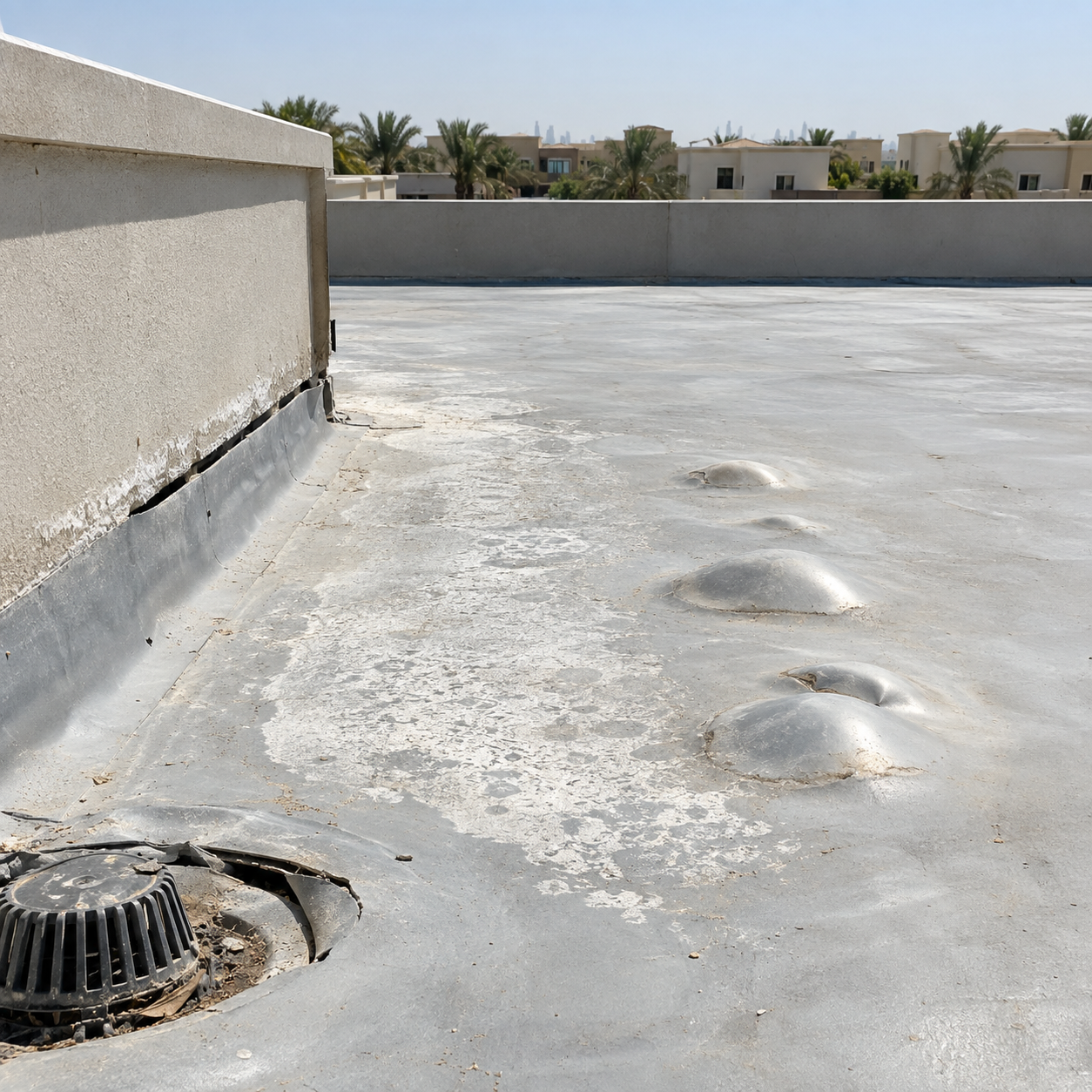
The junction between a flat roof surface and the vertical parapet wall running around the perimeter is the point of most concentrated thermal stress on any UAE rooftop.
The horizontal roof slab and the vertical parapet wall are two different structural elements. They are connected but they move independently. When UAE temperatures change, each element expands and contracts in a different direction. The waterproofing membrane that bridges the junction between them is being pulled in two directions simultaneously every time the temperature changes.
Even a membrane applied perfectly at the time of installation will experience this movement stress. Over years of UAE thermal cycling, the junction progressively weakens. The seal between the membrane and the wall face opens a fraction more with each cycle. Eventually the gap becomes large enough for water to enter, and it does.
This is why nine out of ten UAE villa roof leaks that Servyx investigates originate at or near a perimeter junction rather than in the middle of the roof surface.
What UAE UV Radiation Does to Waterproofing Over Time
The UAE sits between 22 and 26 degrees north latitude. At this latitude, UV radiation levels are significantly higher than in the European and North American markets where most waterproofing products are manufactured and rated.
UV radiation attacks the surface of a waterproofing membrane from the day it is installed. The UV protection in a membrane system is provided by stabilising compounds in the top surface layer, either in the membrane itself or in a separate protective coating applied over it. These compounds absorb UV energy and prevent it from breaking down the underlying polymer structure.
The problem in the UAE is the rate at which those stabilising compounds are consumed. A UV protection layer that would last twelve years in the UK is consumed significantly faster under UAE solar radiation. The surface begins to chalk. It dulls. To the naked eye it often still looks like a roof. But the protection it was providing is gone, and the membrane beneath it is now exposed directly to the same UV radiation that depleted it.
Once the membrane body is directly exposed to UAE UV radiation, its polymer chains begin to break down. The membrane loses flexibility. A material that was once able to stretch and return to its original shape under thermal movement becomes brittle. It cannot accommodate the expansion and contraction that UAE temperatures demand. Cracks form. The cycle that began with UV degradation ends with water ingress.
Why Membranes That Look Fine Are Often Already Failing
This is the part of UAE roof waterproofing that catches most property owners off guard.
A UV-degraded membrane surface does not collapse or visibly rupture. It chalks and dulls. From the ground, from a balcony, even from walking on the roof, it can look completely intact. The degradation is at the molecular level in the polymer structure, not visible on the surface.
By the time visible cracking appears on a UAE rooftop membrane, the UV degradation that led to that cracking has been in progress for one to two years. The crack is the end of the process, not the beginning.
This is precisely why a professional waterproofing inspection is more useful than a visual check by the property owner. An experienced inspector assesses the condition of the membrane surface, its flexibility, its adhesion to the substrate, and the condition of protective coatings in ways that visual inspection alone cannot reveal.
What Coastal Humidity Does to Roof Waterproofing in Dubai
Dubai sits on a coastline. Humidity levels in the city regularly exceed 80 percent during periods of the year, and even inland UAE areas experience humidity levels that would be considered high in most European countries.
High humidity affects waterproofing membranes in several ways that are specific to coastal environments.
Moisture vapour moves through building materials from areas of higher concentration to lower concentration. In a humid environment, moisture vapour pressure beneath a rooftop membrane is higher than it might be in a dry inland climate. This vapour pressure pushes upward against the underside of the membrane. Where the membrane adhesion to the substrate is imperfect, the vapour pressure creates blisters.
Blisters on a rooftop membrane look like raised bubbles in the surface. They indicate that moisture vapour has become trapped between the membrane and the screed beneath it. On a UAE rooftop in summer, those blisters are subjected to 80-degree surface temperatures. The vapour inside them expands. The blister grows. Eventually it ruptures, creating an open hole in the membrane surface directly exposed to rainfall.
What Salt Air Does to Membrane Edges and Junctions
Dubai’s coastal air carries salt particles. Those particles settle on every surface they contact, including rooftop membranes, parapet wall faces, and the sealant joints that protect critical junctions.
Salt is hygroscopic, meaning it actively attracts and holds moisture from the surrounding air. Salt deposits on membrane edges and junction seals maintain a localised area of high moisture exposure even during dry periods. Over time, the salt crystals expand as they absorb moisture and contract as they dry, physically stressing the sealant material they have settled in.
This is a slower process than thermal cycling but a consistent one. The junction sealants on a coastal Dubai rooftop experience degradation from salt activity in addition to the thermal and UV stresses acting on the same points. The combination accelerates the timeline of junction failure compared to what would occur in a similar property in a non-coastal environment.
How UAE Weather Combines to Destroy Roof Waterproofing Faster
Understanding each factor individually gives a clear picture. Understanding how they work simultaneously explains why UAE waterproofing fails significantly faster than the membrane ratings suggest it should.
During a UAE summer day, a rooftop membrane is simultaneously experiencing surface temperatures above 80 degrees causing thermal expansion, intense UV radiation degrading the protective surface compounds, and salt-laden humid air working on every exposed edge and junction.
At night, the same membrane cools rapidly, contracting and placing the opposite thermal stress on the same bond points that expanded during the day.
In winter, occasional rainfall hits a membrane surface that has been through this cycle every day for six months. The rain has an entire summer’s worth of degradation to work with.
A membrane applied in January to a new Dubai villa is in reasonable condition by its first summer. By the end of its third summer, it has been through approximately 540 significant thermal cycles, three seasons of UAE UV exposure, and daily salt air contact at every exposed edge. Even a correctly specified membrane is approaching a period where professional inspection is warranted.
A membrane that was under-specified for UAE conditions, or applied without proper surface preparation, has often already failed before the property owner knows anything has changed.
Warning Signs That UAE Weather Has Damaged Your Roof Waterproofing
You do not need to be a waterproofing professional to identify the signs that UAE climate conditions have damaged your roof. The following indicators are visible to any property owner who knows what to look for.
Signs to Check on the Roof Surface
Blistering or bubbling anywhere on the flat membrane surface indicates moisture vapour trapped beneath the membrane. Each blister will eventually rupture under UAE summer heat.
Chalking of the surface coating, which looks like a white or grey powdery residue that comes off on your hand when you touch the surface, indicates UV depletion of the protective layer.
Lifted tile edges on a tiled roof indicate that thermal movement has exceeded the capacity of the tile bedding to hold the tile in position.
Visible separation between the membrane edge and the parapet wall face at any perimeter junction is an active water entry point.
Signs to Check Inside the Property
Any water stain on a top floor ceiling, even very light discolouration, indicates moisture has already moved through the structure above. The stain represents the end point of a water pathway that started somewhere on the roof.
Bubbling or soft patches in paint on top-floor walls near the perimeter indicate moisture in the wall cavity from a parapet junction failure above.
A persistent damp smell in top-floor rooms without an obvious source is often the result of moisture movement within the structure from a roof waterproofing failure above the insulation.
What a Professional Waterproofing Inspection Finds That You Cannot
A trained waterproofing inspector assesses things that a visual walk across the roof does not reveal.
Membrane adhesion testing checks whether the membrane is still bonded properly to the substrate beneath it, or whether delamination has begun below the visible surface.
Screed moisture testing identifies whether moisture has already penetrated the membrane and is present in the screed layer beneath, which indicates that the failure is more advanced than the surface suggests.
Junction condition assessment documents the specific condition of every parapet wall junction, drainage outlet, and penetration point with photographs, creating a record of where problems are beginning before they become visible inside the property.
UV degradation assessment evaluates the condition of the membrane’s surface protection layer and identifies areas where the membrane body beneath is becoming exposed.
All of this information is documented in a written report that tells the property owner exactly where they stand and what, if anything, needs attention.
Servyx provides free waterproofing inspections for villas and buildings across Dubai. The full inspection includes photographic documentation and a written report delivered on the day of the visit.
The Right Time to Inspect in Dubai
Given what UAE weather does to roof waterproofing, there are two ideal windows for a professional inspection.
October and November is the first. The UAE summer has just finished and every stress the heat, UV, and humidity applied to the membrane over the previous six months is at its most visible. Any weakness created during summer is detectable before the winter rain season arrives.
March and April is the second. Inspecting before summer means that any borderline issues can be addressed while surface temperatures are still manageable for application work. Membrane systems applied in spring conditions cure correctly and can be fully evaluated before peak heat arrives.
Many Dubai property owners who experience a roof leak discover on professional inspection that the damage was already present and detectable during the previous inspection window. The problem simply was not noticed because no one was looking.
Frequently Asked Questions About UAE Weather and Roof Waterproofing
Why does roof waterproofing fail faster in the UAE than in other countries?
The UAE combines extreme heat, intense UV radiation, coastal humidity, and daily thermal cycling in a way that no other major construction market experiences simultaneously. Most membrane products are rated for performance in the climates where they were developed and tested. In UAE conditions, those ratings significantly overstate actual service life.
What does UAE heat do to a waterproofing membrane?
UAE heat causes the membrane and the structure beneath it to expand significantly during the day and contract at night. This thermal cycling creates stress at bond points and junctions that progressively weakens the membrane over time. Junction failures and microcracks develop over multiple seasons before any water ingress is visible inside the property.
How does coastal humidity affect roof waterproofing in Dubai?
Coastal humidity in Dubai creates moisture vapour pressure beneath waterproofing membranes that contributes to blistering and delamination. Salt particles in coastal air also accumulate at exposed membrane edges and junction seals, maintaining persistent moisture contact that accelerates degradation at those specific points.
What are the signs that UAE weather has damaged my roof waterproofing?
Signs include blistering or bubbling on the membrane surface, chalking of surface coatings, lifted tile edges, visible separation at parapet wall junctions, water stains on top-floor ceilings, and soft or bubbling paint on interior walls near the roofline.
How often should roof waterproofing be inspected in Dubai?
Every three to five years is the professional recommendation. Properties in coastal zones of Dubai or those older than eight years without a previous inspection should be assessed as a priority before the next rain season.
Is roof waterproofing inspection free in Dubai?
Servyx Technical Services offers free professional waterproofing inspections for villas and buildings across Dubai. The inspection includes membrane condition assessment, junction inspection, photographic documentation, and a written report.
Protect Your Property Before the UAE Climate Does It for You
UAE weather roof waterproofing deterioration does
not announce itself. The heat, the UV, and the
humidity are working on your membrane every day
of the year without any visible warning until
water reaches your ceiling.. The heat, the UV, and the humidity are working on your roof membrane every day of the year. The question is not whether those forces are having an effect. They are. The question is how far advanced that effect is and whether it has reached the point where water will find a way through.
A professional waterproofing inspection answers that question before the ceiling stain does.
Call +971 55 449 9229 or visit servyxuae.com to book your free inspection across Dubai.
Servyx Technical Services LLC provides professional waterproofing, roof tiling, gypsum ceiling installation, steel structures, and GRC services across Dubai and the UAE. Based in Al Qusais Industrial Area 2, Dubai. Free inspections available across Jumeirah, Mirdif, Arabian Ranches, Dubai Hills, Al Barsha, JVC, Nad Al Sheba, Dubailand, and all other Dubai communities.